
















Signing the Player They Are vs. the Player They’ll Be
June 16, 2026 · Read Time: 7 mins

Despite this proliferation of data across the industry, the transfer market is still incredibly inefficient. With all of the video clubs have, the event data, the tracking data, we’re not seeing the corresponding uptick in transfer success rates.
Rich ByrneHead of Player ID, Teamworks

Football clubs have never had access to more data. Yet the transfer market remains stubbornly inefficient. High-profile signings still fail at alarming rates, and for all the investment in analytics teams, the needle on transfer success hasn’t moved much.
That was the starting point for a recent Training Ground Guru webinar featuring Rich Byrne, Head of Player ID at Teamworks, and Alexander Hinton, Product Scientist at Teamworks, a conversation that got into the mechanics of why recruitment is still so hard, and what it looks like to actually fix it.
The Problem Isn’t the Data — It’s What Clubs Do With It
Clubs across football have invested heavily in data infrastructure over the last decade. More analysts, more data providers, more event data. But as Rich pointed out in the opening, the results haven’t followed.
“Despite this proliferation of data across the industry, the transfer market is still incredibly inefficient. With all of the video clubs have, the event data, the tracking data, we’re not seeing the corresponding uptick in transfer success rates.” — Rich Byrne, Head of Player ID, Teamworks
So where’s the disconnect? Alexander had a clear answer: the difference between generating data and actually applying it.
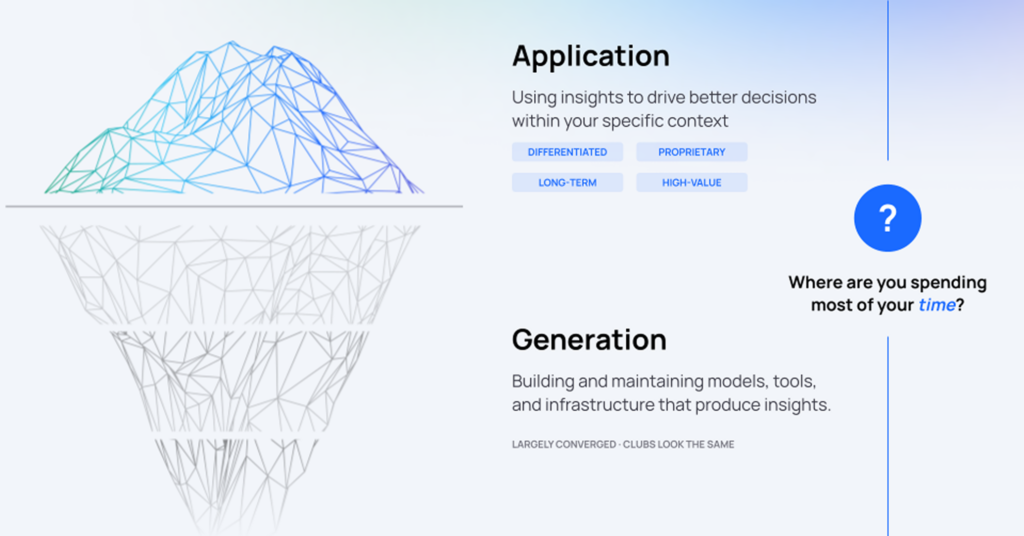
Most analytics teams inside clubs spend the vast majority of their time in what Alexander calls the “generation trap”, building and maintaining data pipelines, answering ad-hoc requests from the medical team, the performance team, the sporting director, the academy. The innovative, forward-looking work, the kind that would actually improve recruitment decisions, gets squeezed out.
More data and investment hasn’t directly linked to better hit rates in the market. The potential differentiation would be in application — club-specific stuff that can’t be bought off the shelf. But without the capacity to get there, that opportunity is still untapped within the industry
Alexander Hinton
Product Scientist, Teamworks
There’s a compounding problem here too: because clubs are largely drawing from the same data providers and similar open-source models, there isn’t actually much differentiation at the generation layer. The edge is in application, and that’s exactly where most clubs don’t have the bandwidth to compete.
Four Stages of Player Evaluation – Where does your club actually stand?
Teamworks Player ID, built on the foundation of Zelus Analytics, co-founded by Moneyball pioneer Billy Beane and former Harvard professor Luke Bornn, uses a four-stage framework to move clubs from raw shortlisting through to genuine predictive projections.
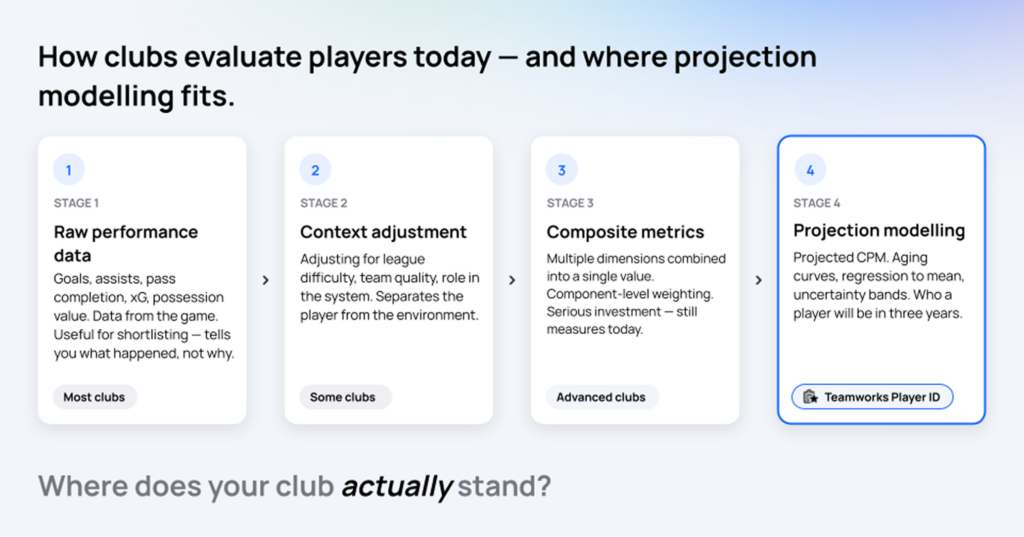
Stage 1: Raw output. Most clubs get here: a shortlist of players ranked by standard metrics like xG, xA, and possession value. It’s progress compared to five years ago, but Rich was direct about its limitations, this is still leaving a lot on the table.
Stage 2: Context adjustment. A player’s numbers don’t exist in a vacuum. Playing as a winger on the dominant team in Portugal, operating in a high-possession system, is a completely different context from playing for a mid-table Premier League side. Stage 2 strips away those environmental factors, such as league difficulty, team style, positional role, to isolate true player skill and make genuine like-for-like comparisons.
Stage 3: Composite metrics. More data doesn’t automatically mean better decisions. Alexander flagged confirmation bias as a real risk: if you have 15 metrics and three models, you can almost always find one that supports the player the manager already wants. A single, principled composite metric, one whose weightings are learned from the data rather than chosen subjectively, removes that problem.
Stage 4: Projection modeling. This is where the real value sits. As Alexander put it:
Understanding who a player truly is today is the necessary baseline, you can’t project forward without it. But when you’re signing a player to a multi-year contract, that snapshot of today is just the starting point. What you’re really buying is who they’re going to be over the length of that contract.
— Alexander Hinton
The projection model does three things: it pulls outlier performances back toward what’s sustainable and repeatable, weights recent seasons more heavily while still accounting for a player’s full career of data, and applies skill-specific aging curves to project performance forward. The result is a validated, mathematically grounded answer to the question clubs are always really asking: what am I buying?
The Nicolas Pepe Warning Shot
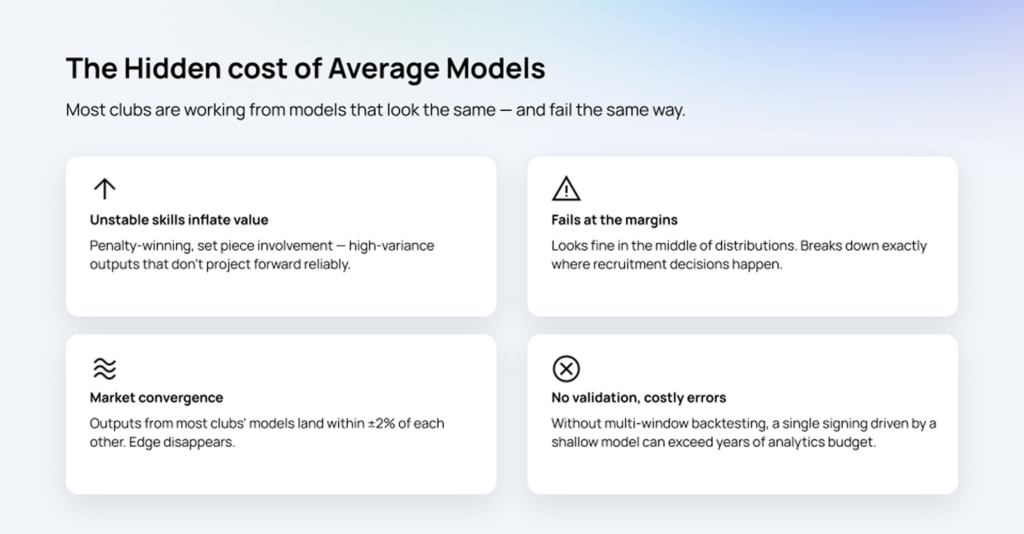
Nicolas Pepe’s 2018/19 Ligue 1 season is a useful illustration of why stress-testing your model matters. That year, Pepe won five penalties. In a standard possession value model, each penalty represents a huge scoring probability spike, from roughly 5% to 80%, which adds approximately 0.1 xG per game to his output over the season. The model reads him as an elite attacking player, and on the raw numbers, it’s hard to argue.
The problem is that winning penalties at that rate isn’t a stable, repeatable skill. It’s noisy, driven by a handful of incidents that don’t reliably recur season to season. Strip those out, and the picture looks meaningfully different.
“What looks like elite attacking output was driven by a handful of high-value incidents. The present looked great, and the future didn’t follow.” — Alexander Hinton
Pepe went on to sign for Arsenal for £75m and had a reasonable career in North London, but not at the elite levels that a standard possession value model from 2019 would have projected. It’s a reminder that the question isn’t whether the data is accurate. It’s whether the model is built to separate signal from noise.
What This Looks Like in Practice
Rich shared two case studies from Teamworks’ partner clubs that show how projection modeling translates into real recruitment outcomes.
Charlie Cresswell at Toulouse. When Toulouse signed Cresswell in summer 2024 for €4.5 million, the Player ID platform projected him as an 85th percentile performing center-back at Ligue 1 standards over the following three to five years — with error bars tight enough to place him between the 70th and 90th percentile with high confidence. Fast-forward to today, and Cresswell’s value has risen dramatically, with clubs from across Europe’s top leagues expressing interest.
Ruben van Bommel at AZ Alkmaar. A higher-uncertainty call. Van Bommel had just one senior season of data at the time, at MVV Maastricht in the Dutch second division. The model projected him as a 70th percentile winger at Eredivisie level, with a wide distribution reflecting the limited sample. AZ bought him for under €500K, assessed that the upside justified the risk, and within two years sold him to PSV for €15.8 million.
Both examples illustrate the same principle: the goal isn’t certainty. It’s a validated, mathematically honest picture of what a player is likely to become, with the uncertainty visible, not hidden.
Advanced Analytics, Not a Black Box
Rich was clear about what Teamworks Player ID is and isn’t.
“Player projections can feel quite black box — and with AI coming on stream, it can feel very voodoo. But what we’re talking about today is really nothing more than advanced analytics by a big, dedicated team of data scientists, which is much bigger than most clubs can resource internally.” — Rich Byrne
Teamworks Player ID currently has 15 full-time data experts with a single focus: valuing players and projecting their future performance. To date, it has been deployed across 22 transfer windows and has advised on over €1 billion in player spend, across partners in the Premier League, Serie A, Ligue 1, the Eredivisie, and the Saudi Pro League.
The aim, in Billy Beane’s framing, is straightforward: supply clubs with the best information available, so they can make the best decisions possible when it comes to recruiting players.
Teamworks Player ID is the predictive analytics platform purpose-built for football recruitment. To learn more, visit Player ID or get in contact with the team below.
Article Topic
How Teamworks Player ID uses predictive analytics and projection modeling to improve football recruitment
Audience
Football club decision-makers
Key Challenge
Football transfer market is highly inefficient
Products Mentioned
Player ID

How the NCAA Found Clarity in the Chaos of March Madness
See how the NCAA used Ask Teamworks to get instant, citation-backed answers to policy, travel, and protocol questions during March Madness.
TCU Selects Teamworks Player Personnel
TCU Football adopts Teamworks Player Personnel to unify self-scouting, advanced scouting, and transfer portal evaluation into one platform, giving AGM Tyler Olker's growing staff a faster, more precise way to build a roster built for the Big 12 and beyond.

The Future of AI in Sports Is Not What You Think It Is
AI in sports is only as powerful as the data behind it. Learn why connected data, not AI models, will define the future of performance.