FCS football is not a stepping stone. For the coaches and staff who pour themselves into it, it is the destination. The challenge has always been doing that work with a fraction of the resources available to programs one division up. That gap is closing.
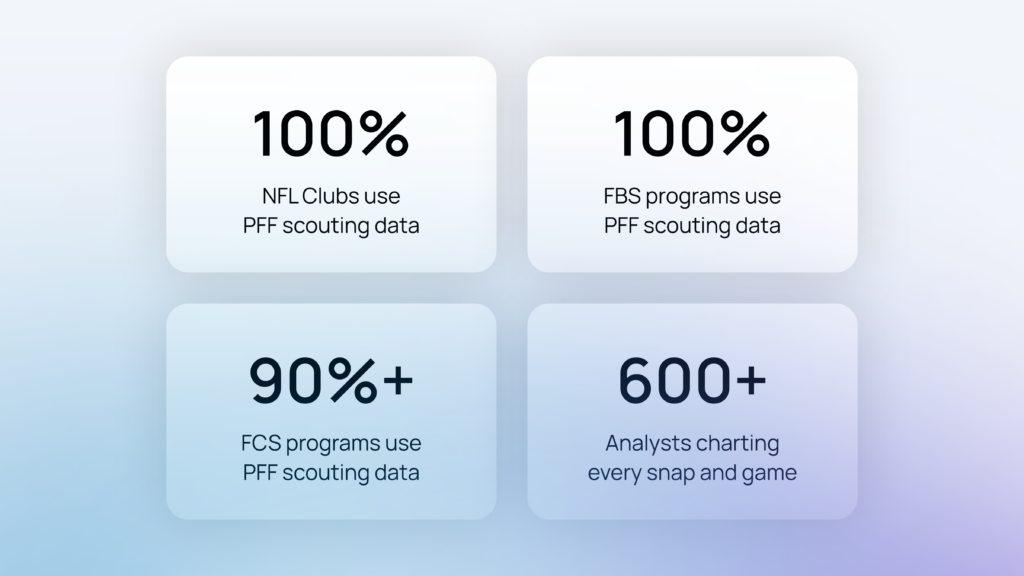
Hampton University and Morgan State University have joined PFF Enterprise, bringing the same human-graded football data used across the NFL and college football’s biggest stages directly into their preparation workflows. With more than 90% of FCS programs already on PFF, the question for those that remain is not if, but when.
Hampton University: Preparing Like a Program Without Limits
Hampton’s football staff didn’t come to PFF looking for a magic number. They came looking for time. FCS staffs are lean by necessity. Every hour spent manually pulling film or building evaluation frameworks from scratch is an hour taken from teaching, recruiting, and developing the players already in the building.
PFF gives Hampton’s staff instant access to graded player data on every snap of every game. Game Key and Play ID linkage means moving from a grade to film without hunting. Game State data surfaces context raw stats never could: down, distance, score differential, personnel groupings, and clock situations that shape what a number actually means. Player Participation tracking shows exactly who was on the field on every play. Tagged Event data captures the specific actions and decisions of every player on every play at a level of specificity that turns evaluation from impressionistic to precise. For a staff on a tight timeline, that is not incremental improvement. It is a different way of working.
“PFF will change the way we prepare,” said Van Malone, Head Coach at Hampton University Football. “Our staff can walk into any gameweek with the full picture: not just what our opponent likes to do, but what we may be giving away ourselves. That context is everything when you’re building a game plan on a short week.”
Hampton is not using PFF to imitate what larger programs do. They are using it to prepare better than programs that have more of everything else.
Morgan State University: Empowering Every Coach on the Staff
Morgan State came to PFF with a specific problem: how do you empower position coaches when the scouting infrastructure Power Four programs take for granted? The answer PFF provides is not a workaround. It is a genuine solution.
When a Morgan State position coach evaluates an opponent or assesses a prospect, they are working from the same data NFL front offices use. Every rep in every game is charted and graded, giving Morgan State’s coaches a level of detail on opponents and prospects that would take a much larger staff days to build manually. Every coach walks into the film room with more context, more specificity, and more confidence that their evaluation will hold up.
“When your staff is lean, every hour matters,” said Gerald Huggins, Director of Football Operations at Morgan State. “PFF gives our coaches the information they need without the manual work to get there. Our guys come into the building more prepared, and that shows up on the field.”
PFF Is Table Stakes to Compete
Hampton and Morgan State are not outliers. They are part of a growing majority that has decided PFF is table stakes to compete. PFF’s infrastructure is unlike anything else in football data: 50+ full-time data and engineering staff, 600+ tagging and grading staff deployed every week of the season to watch every snap and manually tag each player’s assignment, technique, and outcome. Twenty years of investment. Four critical data streams. A system cross-referenced across thousands of games and hundreds of thousands of plays that no competing data provider can replicate.
For FCS programs, the value proposition is concrete. Staff sizes are smaller. Preparation windows are no shorter. The margin for error is no wider just because the division number is different. The programs that learn to use elite data within those constraints will separate themselves from the ones still building evaluation frameworks manually when the season starts.
“We’re thrilled to welcome Hampton and Morgan State to the platform,” said Sam Curtis, Director of Football Product Success. “What we’re building at Teamworks is an end-to-end football technology platform that every level of the game can use to prepare better week to week and ultimately win more games. FCS programs like these are a huge part of that vision, and we can’t wait to bring more on board.”
The question FCS programs should be asking is not whether they can afford PFF. It is what preparation looks like on the other side of having it. Hampton and Morgan State made their decision.
Ready to see what PFF can do for your program?