
















Why Data Is a Culture, Not a Tool – By Gareth Jennings
February 11, 2026 · Read Time: 14 mins
Harburg group owns Al-Kholood, has a minority stake in Cadiz (Spain’s Segunda División) and has ownership of three African clubs.
Presenting at TGG’s Big Data Webinar, Jennings – who is the former Technical Director of the UAE Pro League and Academy Director at Stoke City – explained how the Harburg Group use data not only as a tool, but as a culture.
Gareth Jennings: I first met Ben Harburg in the UAE. I was Technical Director for the UAE Pro League and had gone to visit a facility there. Ben was looking at the facility too, as a potential training camp for Cadiz, the Spanish club he holds a minority stake in.
We started talking about data in clubs and how it’s used. Ben recognised the size of the industry but also how inefficient it was. I shared some insights from my experiences and it seemed we had a common theme around how you could make clubs a lot more efficient in the use of data and how you could influence, recruit and develop using data.
Then we got onto talking about how you could use data to help develop a culture within a multi-club environment.
Ben sent me a Cadiz shirt and a few weeks later I sent him a Grimsby Town shirt, because I sit on the Board there. The friendship took over from there and Ben offered me the opportunity to come on board with the Harburg Group as part of the multi-club group, firstly as part of the leadership board and then as Group Sporting Director, which is the role I hold now.
From my side, data is not just a tool, it’s a culture and a behaviour. It’s not just how we recruit players, it’s how we develop players, how we make performance decisions, how we structure our operations, how we build trust in our environment.
Crucially, it supports our business goals and our cultural identity and that’s what this article is going to be about.
The Harburg Group: A background
Ben Harburg is a global institutional investor who has worked in private equity for a number of years. If you Google him, you’ll see someone who is very comfortable talking in public and who has a really strong passion for the game.
When we go to games, he sits with the fans, because he wants to be with them and understand them.
Harburg Group has 100% ownership of Al-Kholood in the Saudi Pro League. We’re the first foreign-owned and 100% privately owned club in the League.
We also have a minority stake in Cadiz in Spain, where we play an influencer role, particularly around data. Then we have three African clubs, which is mainly around a talent pipeline.
Those clubs have different histories, different cultures, different budgets, different expectations and different football realities. The bit where we’re really trying to unite them is through data.
How data reinforces core values
Our core values underpin everything we do. They are the foundation of our strategy.
Our core values are to be ambitious, innovative, credible, collaborative and human-centric.
- In terms of being ambitious, we’re able to use data to set specific global benchmarks and standards in terms of what we want to achieve, so we can be realistic around the goals and objectives we’re setting within our organisation. Then we can evidence them to people, through an onboarding process and as they go about their day-to-day jobs.
- We want to make sure we’re innovative. This is a responsibility on us as the Senior Leadership Team: to make sure we are tech-first, but also that we’re doing research around the future models that are available to us in terms of data, being able to use it more effectively and efficiently and also recognising where technological advances can add value to us in future.
- Credibility. What we want to do is make sure we’ve got an evidence base that’s really clear and removes risk, but also adds a layer of trust. At the moment, I feel we’re still telling the story a lot within our organisation. Although I’ve worked in data-driven organisations previously – and so too have our owners – we want to try and build that credibility even more and be able to use it as an evidence-based in the work we do.
- Being collaborative: Making sure we’ve got tools available to us that allow us to share data and information. This is about making sure your decision-making is based on data so it’s true and removes risk.
- If we’ve got data and it’s supporting decision-making, can we use it as a tool to identify and support individuals in their roles, so we have a really clear strategy? Can we recognise when there are uplifts in specific areas of work? Can we recognise where there are dips in performance, so we can make sure we support and develop people? Can we use predictive data to look at what the future is going to look like in terms of what skillsets these individuals will need? That human-centric piece is really important. And then making sure that individuals in our organisation know how we’re using data.
Teamworks
When we did analysis about individuals working in the organisations and their data challenges, one of the biggest data challenges that emerged was the number of data providers for different elements of the organisation.
So we’ve really tried to streamline it as much as possible. We know there are going to be other forms and sources of data that we’re going to use implicitly, however, what we felt was really important was to have a data partner for some core areas of our business.
Teamworks have been super helpful to us. They manage and administer a lot of our data through their platforms – in terms of using Teamworks Player ID for recruitment. A key part of that is being able to integrate our game model.
Although we’re using data through a number of APIs, we also wanted to make sure our game model was embedded. Also using Teamworks Hub and Teamworks AMS to make sure that we were centralised in core parts of the business as well.
Teamworks Athlete Management System and Hub – they’re very new to us within the organisation, but we are looking at how to expand that across the group, not just in Al-Kholood.
In terms of being a data influencer in other areas of the group, we’ve used the performance intelligence that we’re taking for the recruitment of players in the Saudi Pro League and are using it to influence our other clubs. That’s been a key tool for us.
Leadership setting the culture
Leadership sets the culture within an organisation. I’m hugely fortunate, because I had a relationship with Ben Harburg prior to coming on board.
I’ve had a management meeting this morning with our Board and I couldn’t just go in and list a number of facts. I had to bring evidence and use data to make decisions.
There can’t be an expectation within the organisation that we use data for player recruitment or player development, but it’s not used at the top.
Part of that is making sure we’ve got an Executive Dashboard for our owners and that data is readily available to them, so we can look at squad-cost modelling, player evaluations and pathways, availability trends, performance, KPIs, market and risk insights and make sure we’ve got good decision-making opportunities within the group, but also that we’re reducing risk around some of those decisions.
I’ve spoken about making sure data is part of our values, which underpins our strategy. So we have a number of areas that we focus on with our strategic plan but also a number of conditions for organisational success that we focus on.
When we speak to staff within the organisation, when we tell the story, we always make sure it’s centred on how strategy is linked to data and how the conditions for our organisational success are also linked to data.
We’re very fortunate that Robert Eenhorn, who was previously at AZ Alkmaar and is a really close friend of Billy Beane, is part of our core leadership team.
And our leadership culture is definitely set from the top. There is an expectation from Ben that I will make sure data is used to evidence our decision-making.
The Group was developed with this in mind, so we knew what that looked like from day one. And we make sure that the staff and people we bring into our organisation have a data-first mindset as well.
What I think is really important is that everyone is part of that story. It can’t just be that it comes from the top – we want to make sure it’s all the way through our organisation.
And that’s everyone, so even our players – we want them to understand why we’ve recruited them, where they fit within our data model, where they fit in terms of their development and the growth of the organisation.
Do pathways exist for them internally within the club or externally? And that’s the same with all the staff. We want them to understand why they’ve come into the organisation and what data we used to identify them when they came in.
Des Buckingham
Our Head Coach at Al-Kholood is Des Buckingham. A number of you will know who Des is. He worked at City Football Group for a number of years, at Melbourne City, then won the Indian Premier League and went onto Oxford United and got them promoted from League One to the Championship.
His win percentage is fairly good and his character profile was a really good fit for us. He could also evidence – and we could use data to evidence as well – how he played football and this was reflective of our game model.
We used our performance partner to look at the individual profiles of players who had played under Des and there was a consistent spike in performance data when they played under him.
This was really important to us, because we are a multi-club group that wants to identify undervalued players, develop them and trade them. We want to bring them into the Saudi market and ideally sell them at a big return on investment.
What we want to do is make sure players are developing in our environment – and what we could recognise from our data provider was that there were big performance spikes in a large number of the players that had played under Des.
Undervalued talent
How do we use data to identify undervalued talent? How can we evidence it and communicate it to staff? How do we make sure it’s used for our talent and development pathways?
We have development plans, not only for the players but for all individuals within our organisation. All of that is done via data and metrics.
We need it to be really meaningful and make sure the strategy is lived and that data sits at the heart of our ability to do that.
This is about objective decision-making, integrated and transparency standards and making sure data is visible to everyone in the context of their role.
What I don’t want is for that data to disappear, or for people within our organisation not to understand how decisions have been made. It’s really important that we are able to translate that to them, so they’ve got a clear understanding of their job role and the context in which decisions are made.
We are also transferring our club from Ar Rass to a Riyadh Campus. As part of that, there will be an Innovation Hub, where we’ll look at innovative methods around technology and the use of data, to make sure the future growth of our organisation is data led.
Unified game model
As part of our initial onboarding process for staff, certainly in a technical and performance context, it was almost a blank sheet of paper.
We felt it was a really important part of our data culture to make sure we had a game model and tactical philosophy around how we play, how we train and then being able to link this into other areas of the business.
Although the game model was written by myself and our Sporting Director at Al-Kholood, Alex Garcia, we made sure it was documented and that there was data aligned to every element, so our decisions could be really well informed.
Part of that process was enabling our technical and performance staff to have input around how our game model should be developed – not just for Al-Kholood but for the broader group as well.
We’ve got some shared principles and tactical anchors that will be core across the group. However, some will also be based on the context of the league, with some tactical flexibility allowed within that, because we want to get specific performance outcomes based on the results of games and individual players.
This is for player development and also to get return on investment, because we want to sell players into specific markets.
The game model was a really big piece for us and continues to be developed. We have some blocks of time where we have game model monitoring, so a specific number of games where we use the data to tell us whether our performance is reflective of the game model.
We have a reporting process that goes back into the Board around that. We also look at training data to whether it is reflective of the game model data and our monitoring of performance on the pitch.
Player profiles & metrics
Linked into this, we have specific role profiles.
This is just a snapshot of some of the data that we’ve pulled out of the Teamworks Player ID. We have a number of different parameters that are really specific to us. Our intelligence data uses onboard event data and we also have an API for physical and tracking data.
What we’ve also done is put an additional layer on top of that: our specific game model for the Group. And we’ve added templates for each role-specific profile. We have some other data that feed into us around character profile as well
Key takeaways
In terms of the multi-club group and making data the heart of our culture, what is really important is making sure it comes from the top while not neglecting everybody else.
Culture starts with leadership, but staff and players are part of that ecosystem.
What’s really captured my imagination has been that when we’ve shared broader data with players, they have been really interested and have wanted more information. That has been a key part of them buying into us as a club and also as a Group.
Our data partner Teamworks has been absolutely key to us getting a level of consistency, so we breed familiarity in terms of what we do across a number of core areas of our business.
We’ve also done a number of years’ research around which different providers can provide us with specific tools, who we work with and who is the best fit.
And then the most important bit is how data reinforces your values, strategy and long-term goals.We want to protect our staff and players and use data as not just a tool on a daily basis, but something that is going to inform their decision-making, support their development and help them grow with the organisation.If you’d like to watch the full webinar, or learn more about Player ID, get in contact with us.

Related Content
How the NCAA Found Clarity in the Chaos of March Madness
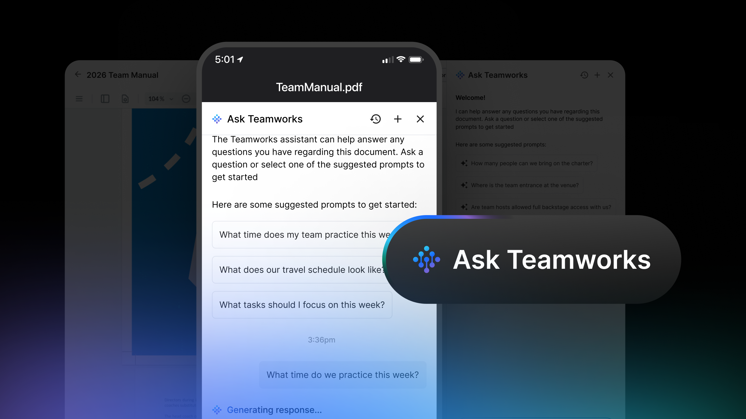
See how the NCAA used Ask Teamworks to get instant, citation-backed answers to policy, travel, and protocol questions during March Madness.

TCU Selects Teamworks Player Personnel
TCU Football adopts Teamworks Player Personnel to unify self-scouting, advanced scouting, and transfer portal evaluation into one platform, giving AGM Tyler Olker's growing staff a faster, more precise way to build a roster built for the Big 12 and beyond.
The Future of AI in Sports Is Not What You Think It Is
AI in sports is only as powerful as the data behind it. Learn why connected data, not AI models, will define the future of performance.