
















Teamworks GM Brings Football Performance Data Into Your Budget Decisions
May 13, 2026 · Read Time: 6 mins
Article Topic
Teamworks GM now surfaces proprietary on-field football performance data directly alongside financial and roster data, so college football programs can make faster, more informed budget and roster decisions in one place.
Key Challenge
Player performance data and financial data live in separate systems, forcing programs to manually piece together information before making high-stakes budget and roster decisions.
Products Mentioned
General Manager, Player Personnel
The data is out there. The problem is bringing it all together.
If you’re running a college football program, you already know the challenge. You’ve got budgets in one place, contract data in another, and player performance information scattered across scouting reports, spreadsheets, and third-party databases. Making a sound roster or budget decision means toggling between systems, manually pulling data together, and hoping nothing slips through the cracks. It’s time-consuming, error-prone, and a tough way to stay competitive.
This isn’t just an inconvenience. When millions of dollars and roster spots are on the line, fragmented data means slower decisions and missed opportunities. Programs need a better way.
What General Manager was built to do
Teamworks General Manager (GM) was built specifically for the revenue share era, because nothing quite like it existed before. It’s the only end-to-end solution for collegiate programs to manage budgets, roster planning, contracts, and payments. From building and managing your NIL and revenue share budget to contracting and paying hundreds of athletes efficiently, GM gives football programs the infrastructure to compete year over year.
But GM has never just been about financial management. It’s about making smarter decisions with better data. Features like Earnings Benchmarks put real market context behind every budget call, pooling de-identified transaction data across Teamworks schools to show you anonymized earnings trends by sport, conference, and position. Whether you’re defending a budget to your AD, setting athlete valuations in negotiations, or figuring out where you’re over- or under-investing at a position group, Earnings Benchmarks gives you the market intelligence to back it up.
Now, GM is going further — and this is just the beginning. With Teamworks’ recent acquisition of Pro Football Focus (PFF)’s enterprise business, the amount of proprietary football data coming under the Teamworks roof is growing significantly. That data will continue to flow into Teamworks products over time, meaning the insights available to programs in GM will only get richer. Player Personnel Insights is a first look at what that future looks like.
Introducing Player Personnel Insights
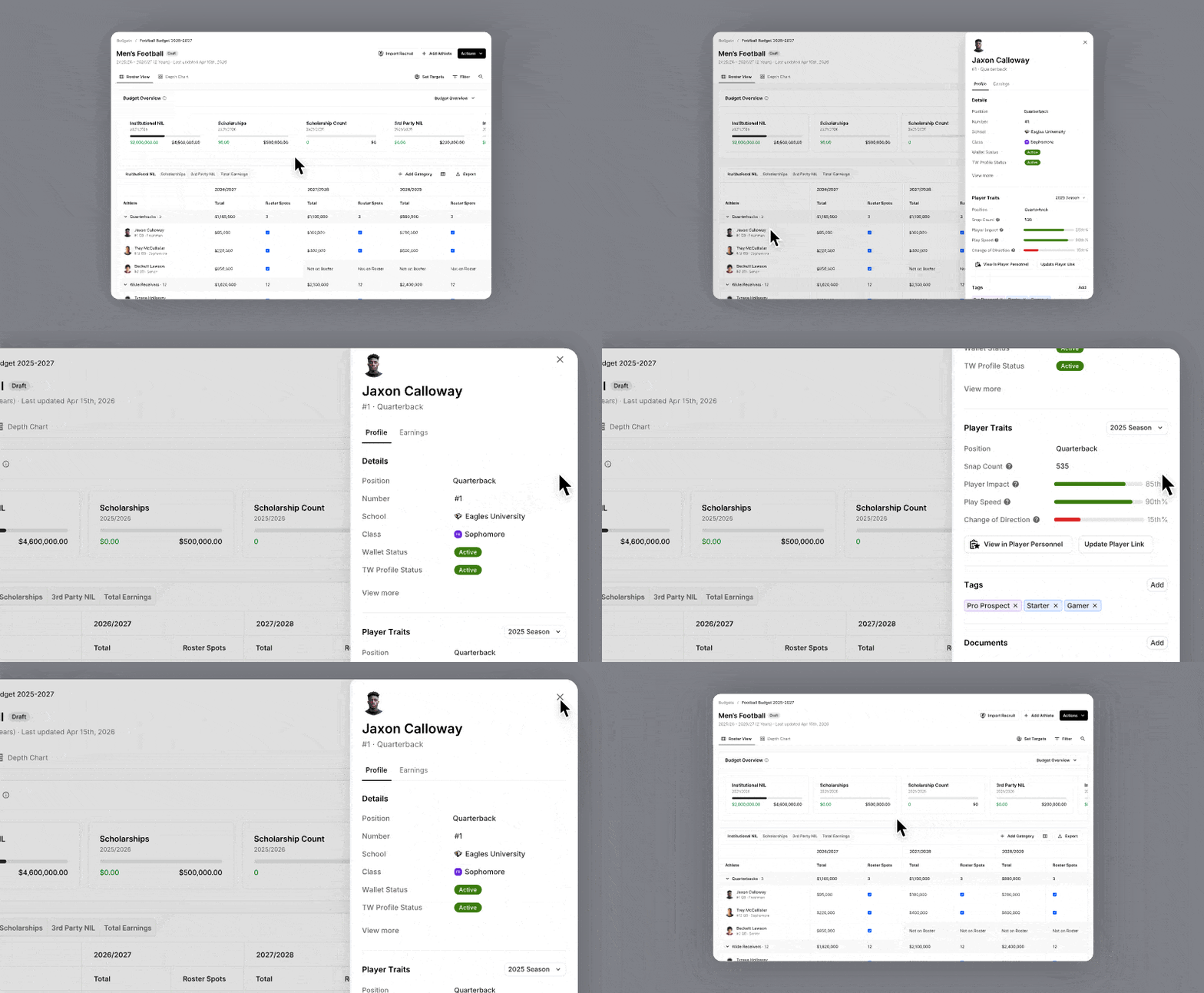
Player Personnel Insights bring proprietary football performance data directly into the GM athlete profile, so your team can evaluate athletes where they already work. Available to all GM users, it surfaces key on-field metrics right alongside contract and roster data, giving GMs, coaches, directors of player personnel, and administrators a more complete picture without ever leaving their workflow.
And it’s not just for your current roster. Programs can use these insights when building budgets around prospective recruits and transfer targets too, so the data is working for you at every stage of the roster-building process.
For college football programs, that means performance data in the same place you’re making budget and roster calls.
The metrics — and why they matter for budget decisions
Player Personnel Insights surface four key performance metrics, each displayed as positional percentiles and filterable by season. Think of it as a snapshot — a curated set of decision-relevant data from Player Personnel, surfaced right inside GM. Everything is derived from tracking data, not subjective grades, which means you’re getting an objective read on how a player actually performs. Here’s what each metric tells you.
Player Impact
Player Impact is a percentile ranking that measures a player’s on-field production relative to others at their position across FBS, based on playing time and performance. It’s a strong signal for evaluating players who are seeing the field consistently — and for spotting mismatches between budget allocation and production.
For budget decisions, it’s a useful gut-check. A high-paid player at a low percentile is worth a closer look before you’re locked into a renewal. A player outperforming their deal is where you’re getting real value. Just keep in mind that Player Impact reflects what a player has produced, not their ceiling — so it’s best read alongside the other metrics and your own scouting context.
Snap Count
Snap Count tells you how often a player is actually on the field. A high budget allocation paired with a low Snap Count is a question that deserves an answer. Is this player not playing because of recurring injuries? A coaching decision about fit or scheme? A depth chart issue? The reasons matter, and Snap Count is what prompts you to ask.
Play Speed
Play Speed estimates a player’s 40-yard dash time using frame-by-frame tracking data, measuring speed and acceleration at every moment on the field. Because football programs already rely on the 40-time as a benchmark for evaluating athleticism, it’s an intuitive way to assess speed — grounded in how a player actually moves in-game, not just a combine number from months ago.
Change of Direction
Change of Direction measures how efficiently a player breaks, factoring in speed, acceleration, and the angle of the cut. Each player’s score is then compared against similar movements across their position, so the evaluation is always position-relevant.
The season filter across all four metrics enables users to toggle between seasons and see how a player’s production has trended over time, potentially changing the nature of retention and NIL conversations. You’re not just evaluating where a player is today. You’re evaluating the direction they’re heading.
Want to go deeper? Player Personnel has you covered.
For programs that use Teamworks Player Personnel, GM’s insights are just the starting point. From a player’s GM profile, you can jump directly to their full profile in Player Personnel, where you can access additional position-specific player traits, advanced stats, leaderboard views, comparative analysis, film, and the full depth of evaluation your personnel staff relies on. It’s a natural handoff between the financial picture and the on-field performance picture, built into the workflow.
One place for the full picture
The revenue share era has made college football more complex than it’s ever been. Programs are managing real payroll, real contracts, and real market dynamics, often with lean staffs and tight timelines. The last thing anyone needs is more data spread across more places.
With Player Personnel Insights, GM takes another step toward being the single source of truth for roster and budget decisions. Financial data, market benchmarks, and on-field performance, together, in context, where you need them. That’s the future of how winning programs will be built.
Better data. Faster decisions. Stronger rosters. See what GM can do for your program — let’s talk.