
















How Pitt Football Leverages Teamworks Player Personnel
September 1, 2026 · Read Time: 3 mins
Pitt's personnel department turned Teamworks Player Personnel into a daily edge, moving faster and covering more ground when the transfer portal opens.
Casey Wasserman opens Teamworks Player Personnel before his first cup of coffee, and it's still open when he leaves the building. Most of his day as Pitt's Director of Player Personnel happens inside it: checking boards, running comparisons, tracking how his own roster stacks up against everyone else's. "It's about doing more with the time you have," he says.
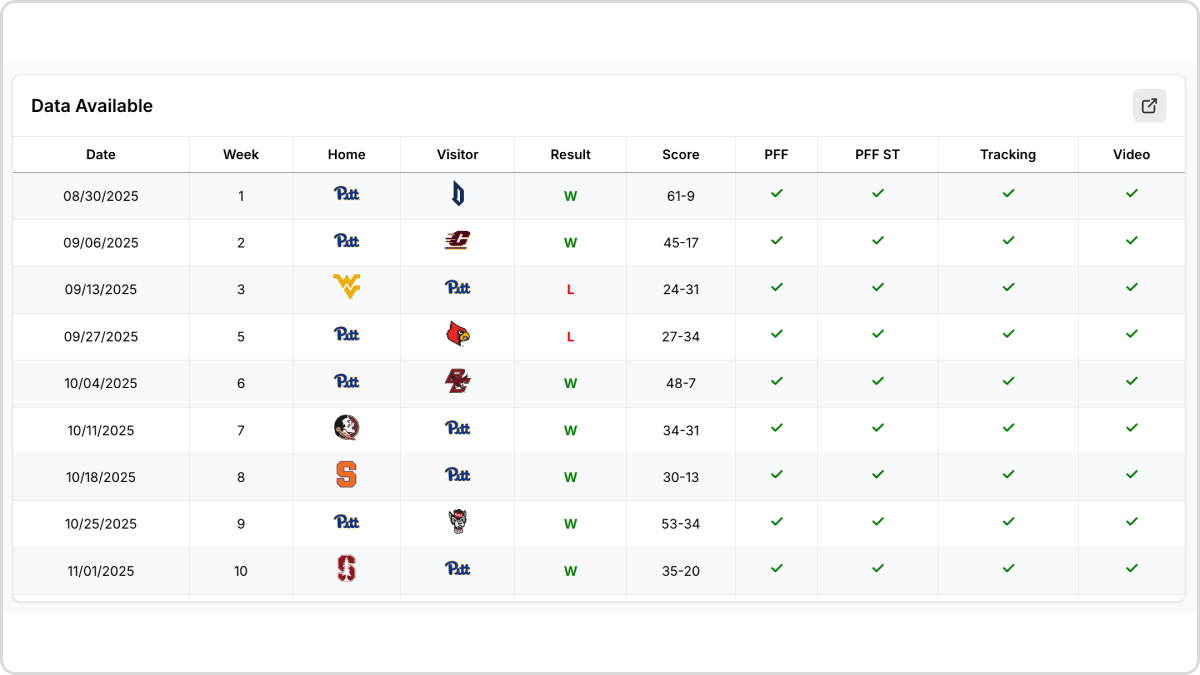
That habit pays off most when the transfer portal opens. Pitt's boards are already built and ranked before the window starts, so when something breaks unexpectedly, a decommit, a starter announcing he's transferring out, a position suddenly thin, Wasserman isn't starting from zero. He's getting an answer in minutes instead of days. “You need to shrink the player haystack fast and Player Personnel helps us do that,” he says.
It's tempting to assume a platform like this only pays off for programs with a deep personnel staff already in place. Pitt's own history argues otherwise. Before Teamworks Player Personnel, the program's scouting ran on coaches' film and hand-built spreadsheets, covering the same number of players with a fraction of the help. That's exactly the situation where the platform does the most work.
Built for a Leaner Staff
Adding staff isn’t always realistic, so the lever was seeing more without adding headcount. Pitt keeps a ranked board of the top players at every position, updated continuously. When transitions happen, the next name is already identified, graded, and ready to send to a coach.
Before Teamworks Player Personnel, Sam Kukura, Pitt's Director of Scouting at the time, graded talent by hand: every eligible player evaluated off All-22 film, no shortcuts. It worked, but it nearly buried the staff. By his own estimate, it would have taken three times as long without the platform. "I honestly don't know what I would have done without Player Personnel," he said.
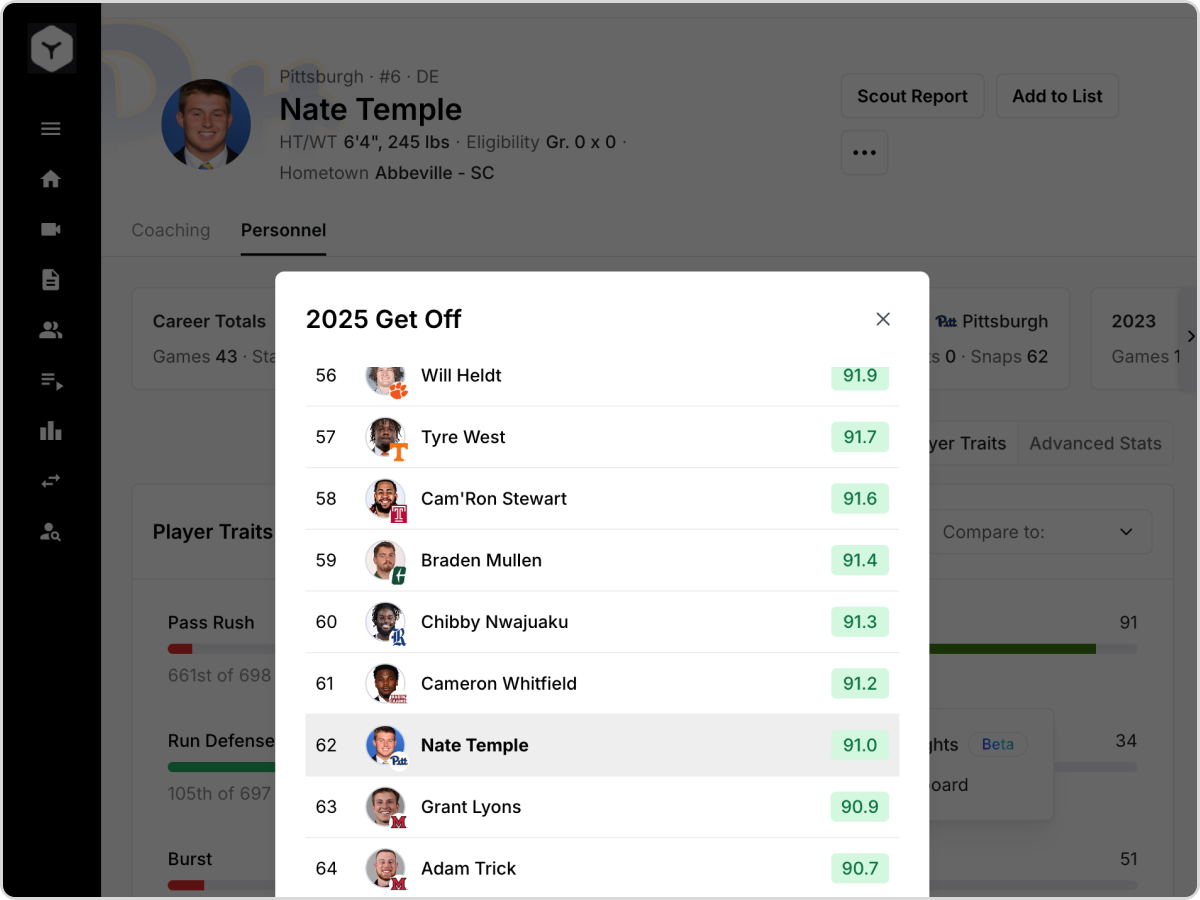
What changed wasn't how many players Pitt needed to see. It was how much time drained into players who were never going to make the roster. The department filtered by the exact traits its coaches valued: get-off and change of direction for a d-lineman, straight-line speed for a receiver, size and snaps up front. A player with 150 snaps and red grades across the board never earned a click. Kukura stopped burning, in his words, “three hours of my day clicking on guys who have zero chance of playing at this level.”
The Portal Test
The test came when a committed d-lineman pulled out and Pitt's backup options evaporated. Once the portal opened, the staff filtered the available pool for a single trait, get-off, surfaced a name near the top, and got the tape in front of the position coach right away. He liked what he saw, and the staff moved quickly through the normal recruiting process to get the player on campus. Kukura traced the win to credibility: get the coach a player worth signing, never “showing him junk” that costs the department its trust.
That's the real case for Teamworks Player Personnel at Pitt, and for any program sizing it up from the outside. It doesn't require adding headcount. It lets a lean staff compete on the same clock as the sport's biggest departments, fast enough to act the moment the portal opens and backed by enough data that no coach has to just take someone's word for it.
Kukura has since moved on to a new opportunity outside college scouting. Wasserman now runs the department, and what stays is the blueprint: player traits and film over guesswork.