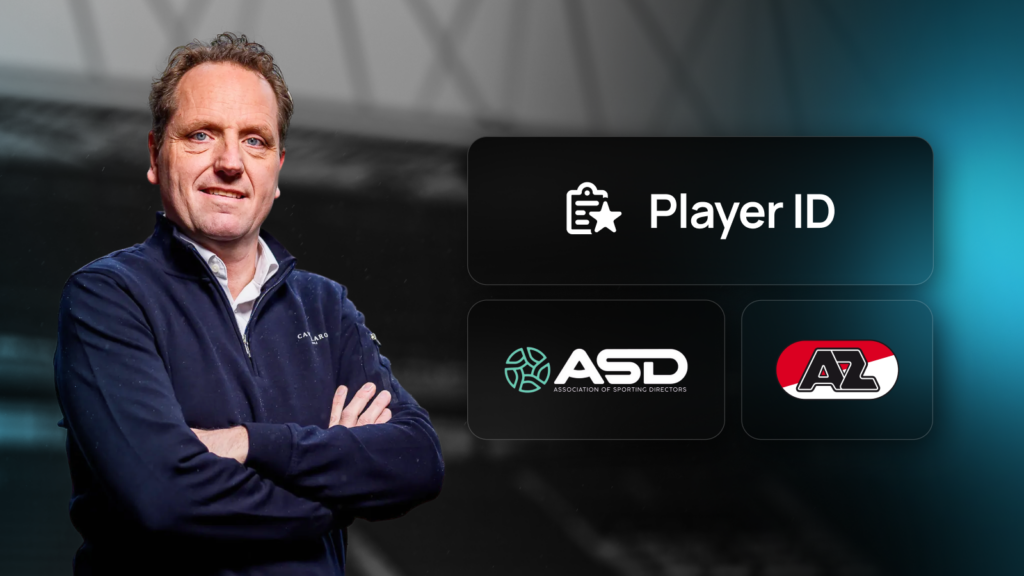
In a recent Association of Sporting Directors webinar, Rich Byrne (Commercial Director, Teamworks Player ID) sat down with Merijn Zeeman, CEO at AZ Alkmaar, to explore the future of football recruitment, and what it truly means to build a data-driven culture.
Drawing from his transformative work in professional cycling and now applying those lessons in football, Zeeman offered a candid, practical look at how clubs can outsmart, not outspend, the competition.

From Cycling Crisis to Culture-Driven Success
Before joining AZ, Zeeman helped rebuild Team Jumbo-Visma (formerly Rabobank) during one of the most turbulent periods in cycling history. After losing its main sponsor and operating on one of the smallest budgets in the WorldTour, the team had two options: shrink or evolve.
They chose evolution.
The transformation wasn’t purely tactical, it was cultural. The team rebuilt from the ground up, establishing core values, removing ego from decision-making, and committing to innovation. Data became central not as a trend, but as a necessity.
A defining example? Signing Jonas Vingegaard, a rider no other team wanted, based on data signals others had overlooked. Three years later, he won the Tour de France.
The lesson: Competitive advantage isn’t always about resources. It’s about conviction in your process.
Translating Lessons to Football
At AZ Alkmaar, Zeeman is applying the same philosophy.
Rather than trying to change everything at once, the focus has been on identifying the two or three areas where the club can truly differentiate. For AZ, operating without the financial power of Europe’s elite, that means being sharper, more objective, and more disciplined in decision-making.
One area of particular focus: recruitment.
Data vs. The Eye Test
Every club today has scouts. Most have analysts. But Zeeman argues the real edge lies not in having data, it lies in how decisively you commit to it.
He described the common tension: a scout passionately recommending a player after live viewing, only for the player’s data profile to disappoint. These moments create friction, but they also create opportunity.
Quoting behavioral psychology research (inspired by Daniel Kahneman), Zeeman emphasized how human judgment is susceptible to bias, narrative, and emotion. Data, when used properly, introduces objectivity.
That doesn’t mean removing humans from the process. Instead, AZ has clearly defined roles:
- Data informs player quality and predictive value (using Teamworks Player ID)
- Live scouting evaluates personality, behavior, and team fit.
- Final decisions follow a structured, transparent process led by the technical director and leadership team.
The key principle: data is the foundation. The human layer is additive, not overriding.
Why Work With External Models?
A natural question followed: if AZ has its own data team, why partner with a platform like Teamworks Player ID instead of building everything internally?
Zeeman offered a simple analogy.
Playing recruitment without robust predictive models is like playing poker against a professional. You might win once or twice. But over 100 hands, the professional will win more often.
Recruitment decisions are multi-million-euro bets. Over time, a disciplined data-led approach produces a higher success rate than intuition alone.
Crucially, Zeeman stressed the importance of transparency. If a club is going to base transfer decisions on predictive models, leadership must understand them. Education and clarity build trust, and trust enables alignment.
“If you are going to spend millions on players, you need to understand why the models are surfacing these players.” – Merijn on Transparency vs. Black Box Model.
“Data-Driven Is Not Romantic”
One of the more striking points raised was cultural resistance.
In football, being openly data-driven can be perceived as “not romantic.” Fans and media often prefer traditional narratives: instinct, character, passion. For larger clubs under intense scrutiny, leaning too heavily into analytics publicly can create backlash.
For clubs like AZ, however, operating intelligently is non-negotiable.
Without the commercial power or global fanbase of bigger clubs, AZ must find marginal gains wherever possible — and data provides that leverage.
Process Over Ego
What gives Zeeman confidence that the approach works?
Not short-term results. Not individual signings.
Process.
He emphasized the importance of:
- Removing blame culture.
- Reviewing decisions honestly.
- Learning from every transfer window.
- Trusting the long-term signal over short-term noise.
Even when a player underperforms initially, AZ maintains conviction in the data. Adaptation periods vary. External factors exist. But if the profile is strong, belief in the process remains.
“We have so much confidence in the data that we believe if a player falls short in the first year, in the end he will succeed.”
The Bigger Challenge: Balancing Value Creation and Winning
AZ has generated significant transfer revenue in recent years. But Zeeman was clear: financial success alone is not enough.
The ongoing challenge is balancing:
- Developing and selling players to sustain the club financially.
- Building a mature enough squad to compete for trophies.
It’s a debate happening inside the club right now, and one that many development-focused clubs across Europe face.
Final Takeaway
The webinar made one thing clear: data is not just a tool. It is a mindset.
It requires:
- Cultural alignment.
- Transparent processes.
- Education across departments.
- Courage to resist external noise.
- Long-term conviction.
For AZ Alkmaar, recruitment is not about chasing hype. It’s about reducing bias, increasing probability, and making better decisions more consistently over time.
As Zeeman put it, you may not win every hand. But over 100 hands, the disciplined approach wins more often. And in modern football, that edge compounds.
If you’re rethinking how your club approaches recruitment, alignment, and predictive modeling:
Connect with Rich Byrne to continue the conversation or explore how Teamworks Player ID supports data-driven recruitment.