Track community impact and celebrate your athletes’ commitment to service.
$3.22 million in community impact. 101,346 hours. 35,603 check-ins. 24 schools.
Student-athletes don’t just compete—they show up for their communities in ways that rarely make the box score.
Across 24 athletics departments already using Teamworks to track community service, the numbers tell that story clearly: 101,346 hours given. An estimated $3.22 million in community impact.
Real hours, logged by student-athletes who give back as naturally as they compete. They represent something bigger than a stat: proof that when student-athletes have a system behind them, the story of their service becomes impossible to ignore.
Spreadsheets weren’t built for telling your community service story.
Across athletics departments, community engagement participation data often lives in disconnected places: a shared Excel file, email chains, and someone’s best guess at how many hours actually happened. Reporting becomes time-consuming, recognition becomes inconsistent, and the full value of the work gets harder to communicate to leadership, donors, and campus partners.
That’s the gap Community Engagement in Teamworks Academics was built to close—a centralized, streamlined way to track hours, measure impact, and report with confidence, all inside the workflows your team already uses.
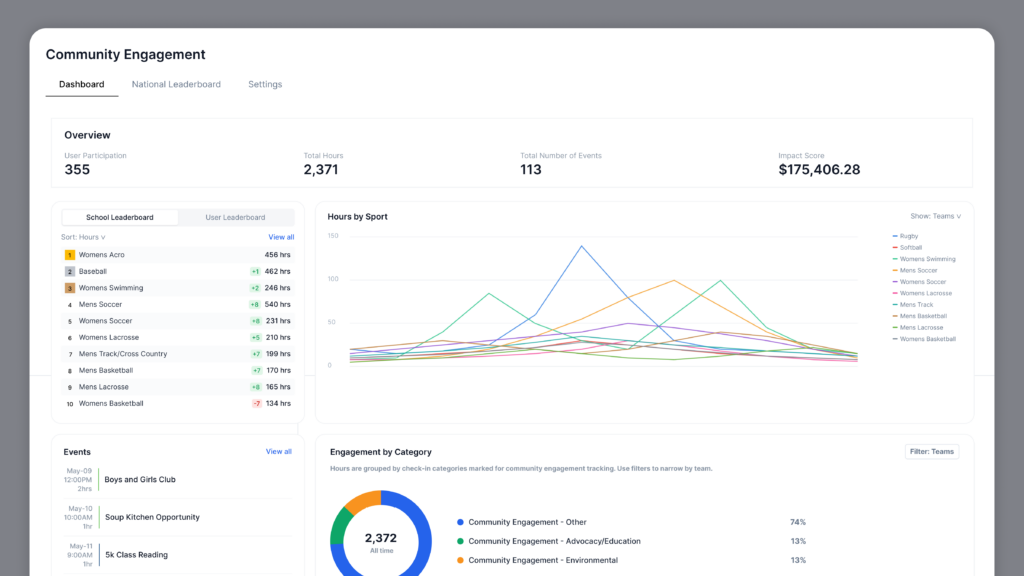
What’s new: Community Engagement in Teamworks Academics
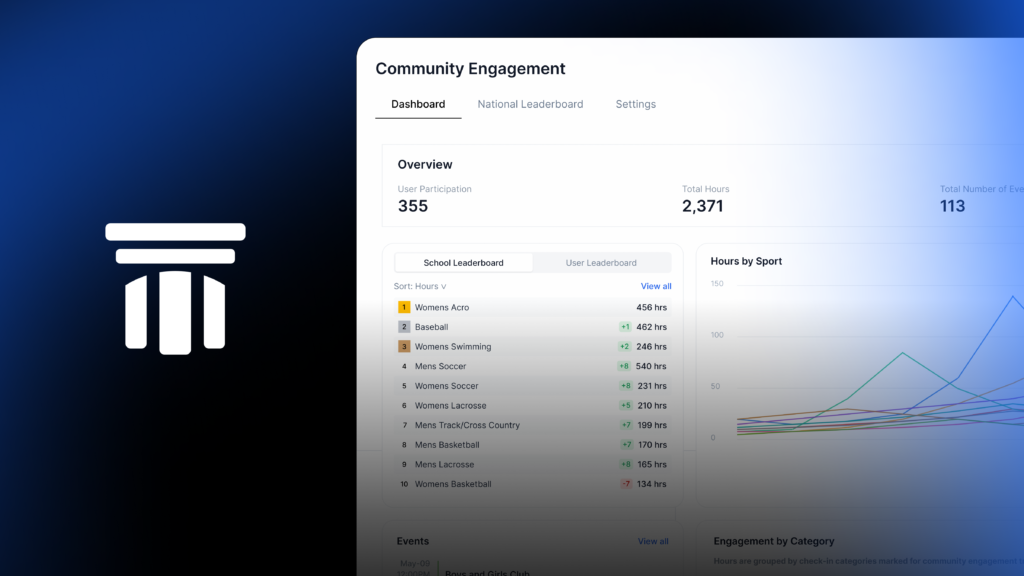
Community Engagement replaces manual work and brings community service tracking into one structured place so you can:
- Log and approve volunteer hours in a consistent workflow
- Report at the department, team, and student-athlete level
- Recognize participation with leaderboards and visibility
- Quantify value with an impact score designed for senior leadership reporting
At Austin Peay State University, a department that has logged more than 20,000 community service hours since partnering with Teamworks, the timing couldn’t be better. As Dr. Kristal McGreggor, Associate Director of Athletics for Student-Athlete Success & Strategic Initiatives, put it: “Having stronger systems and more intentional reporting tools has become increasingly important in helping us track engagement, strengthen accountability, and better tell the story of our student-athletes’ impact within the community.”
How Community Engagement Works
1) Set up categories — so reporting is meaningful
Community service tracking data is only as useful as the structure behind it. In Community Engagement, departments can configure check-in categories so hours roll up into the right buckets—and can be broken down later for reporting, awards, and storytelling.
For many departments, this is genuinely new territory. At Austin Peay, the previous platform had no category structure at all, meaning all hours were tracked as general community service. The team is now building something more intentional:
“As we prepare for the 2026–27 academic year, we are beginning to think more intentionally about how we want to structure categories in a way that reflects the types of engagement our student-athletes are participating in. Our student-athletes regularly serve in a variety of spaces—schools, youth organizations, parks, nonprofits, and community events—so we see this as an opportunity to create more structure and gain better insight into where our student-athletes are making an impact.
My biggest recommendation to another institution would be to be intentional but keep the structure manageable. One thing we have already learned is the importance of creating categories that are clear, meaningful, and easy for student-athletes and staff to consistently utilize within the platform.” — Dr. Kristal McGreggor, Austin Peay State University
The category structure also opens a new layer of strategic insight: understanding which community partners your athletes work with most and identifying trends that can strengthen those relationships over time.
2) Track participation through familiar workflows
Community Engagement is designed to feel intuitive inside Teamworks Academics. The goal is fewer “extra steps,” not more.
Built on workflows you already use (QR scanning + check-ins)
Because Community Engagement lives inside Teamworks, students and staff can use the same Teamworks experience they already know for QR code scanning and check-ins. That means faster adoption and fewer tools to manage, without needing to roll out a separate, external solution just to track participation.
One of the most meaningful changes for departments with large rosters is where participation actually gets logged. At Austin Peay, coaches and staff previously had to submit numbers separately—which meant manual entry and a slower, less accurate process. That’s changed:
“Now, coaches are able to directly submit their community engagement hours through the platform for approval, which will make the process more streamlined and accurate.” — Dr. McGreggor
This shift moves ownership closer to the people closest to the work—and reduces the administrative burden on central staff.
3) See the story instantly: dashboard + leaderboards
Once data starts flowing, you can view it at multiple levels—department, team, and individual—so recognition and accountability don’t have to be manual efforts.
For Austin Peay, where community service is a required part of the student-athlete experience and a major component of their Govs Cup competition, real-time visibility has changed how the staff monitors engagement:
“One of the biggest benefits has been the accessibility and visibility of the data. Everything is now centralized and easy to access, which has made managing community service significantly more efficient for our department. The information is right in front of us in real time.
I also appreciate the live updates and trend features within the platform. Being able to see weekly increases or decreases in participation helps us monitor engagement more proactively and identify areas where additional encouragement may be needed. Student-athletes are required to complete a minimum of 25 hours of community service, so having immediate access to this information allows us to quickly communicate with coaches and continue encouraging student-athletes to stay engaged and on track.” — Dr. McGreggor
That kind of proactive visibility—knowing which teams are trending down before the end of the semester—is what separates a reactive reporting process from a strategic one.
4) Export reporting that’s ready for senior leadership
For many departments, reporting is the job—and it often takes the most time. The export experience in Community Engagement removes the manual math and formatting that makes end-of-semester reporting a scramble.
“The reporting features allow us to quickly see how teams and individual student-athletes are performing on a larger scale, which has been extremely helpful when sharing updates with coaches, administration, and senior leadership. It has also helped create greater awareness among our student-athletes, especially since community service is a major component of our Govs Cup competition and something we regularly discuss during SAAC meetings.” — Dr. McGreggor
When reporting is this accessible, it stops being an end-of-year burden and becomes an ongoing rhythm—team-level summaries for coaches, individual detail for award nominations and compliance needs, and department-level rollups for leadership.
Reporting isn’t just administrative. It’s how you prove value.
Community engagement programs don’t struggle for recognition because their athletes aren’t participating. They struggle because the work is hard to capture consistently and even harder to translate into a story leadership can act on.
When hours live in spreadsheets and email threads, reporting turns into manual math, and recognition becomes inconsistent. That makes it difficult to answer the questions that matter most:
- What causes are we supporting, and how does that connect to awards, storytelling, and donor priorities?
- Which teams are participating, which are exceeding expectations, and which are falling below our standards?
- What is the real, measurable value of the time our student-athletes are giving back?
Community Engagement reporting in Teamworks Academics is designed to answer those questions—turning service participation into clear, repeatable evidence. In beta conversations, the multi-tab export consistently surfaced as one of the biggest “wow” moments, because it eliminates the most painful parts of reporting: building the spreadsheet, formatting it, and doing the calculations by hand. And the built-in individual student breakdown directly addresses what multiple schools identified as their number one pain point.
Senior leadership-facing impact changes the conversation
Many departments are already doing meaningful work. The gap is being able to communicate it in terms leadership understands. That’s why the impact score and dollar-value framing have resonated so strongly with beta partners—it gives athletic directors and academic leadership a clear way to see the tangible value of the program.
And because Community Engagement lives inside Teamworks Academics rather than a separate tool, it fits naturally into the workflows and reporting expectations departments already have. The data doesn’t have to travel anywhere to become useful.
Community Engagement in action: See a live demo
Community Engagement is built to help departments track service participation and translate it into a story leadership can understand—and student-athletes can rally around.
If you’d like to see how Community Engagement works, we’re hosting a live demo webinar on June 1. [Register here.]