



University of Utah Athletics runs its performance operations on Teamworks Performance – including High Performance (AMS), S&C, and Nutrition – creating the connected foundation behind its integrated model.
In a recent webinar hosted by Luke Barthel, Senior Account Executive at Teamworks, Utah’s leadership shared how they built an aligned performance team.
What stood out wasn’t just their structure. It was their commitment to consistent communication, transparency, and trust.
Utah didn’t approach integration as a buzzword or a technology rollout. They approached it as shared responsibility across strength & conditioning, sports medicine, sport science, nutrition, and sports psychology.
As Anna Cruse, Assistant Athletic Director for Applied Health & Performance Science at Utah, said during the conversation:
“When you look at everything holistically instead of in silos – everything changes.”
That mindset defines Utah Performance.
A Shared Model Across Departments
Utah organizes each sport around a dedicated Sport Performance Team (SPT), bringing together strength & conditioning, sports medicine, sport science, nutrition, and sports psychology.
These groups don’t function as separate departments – they operate as one team, communicating consistently and sharing responsibility for athlete outcomes.
Cody Lockling, Assistant AD of Sports Performance for Olympic Sports, described it clearly:
“When we’re aligned on the shared outcome, you can feel it day to day. We’re not chasing different goals, we’re working toward the same one.”
That alignment is visible to athletes and coaches. They hear one message and they see one coordinated team. And that clarity builds trust, which ultimately drives buy-in.
The Turning Point: Centralized Visibility
As Utah continued strengthening their collaboration, they recognized an opportunity to elevate it further: bring their performance ecosystem into one connected environment.
Performance data, medical documentation, nutrition metrics, and readiness insights all carried value. Centralizing that information would make collaboration even more seamless.
Associate AD for Health & Performance Patrick Jenkins described the moment clearly:
“We had to centralize all this information that was living in different places. It took too much effort to gather it, synthesize it, and bring it somewhere we could all see it. We had to get rid of that.”
That commitment led Utah to implement Teamworks High Performance (AMS).
With shared context available in real time, conversations became more efficient. Adjustments happened sooner and alignment became easier to sustain across all of their teams.
Mental Health Integrated, With Guardrails
One of the distinctive elements of Utah’s model is how mental health is included intentionally.
Sports psychology isn’t siloed or treated as an isolated service. It’s embedded within the performance ecosystem. Mental performance and wellbeing are part of the broader conversation. At the same time, privacy remains paramount.
Sensitive information is protected through structured access and clear boundaries. Mental health isn’t overshared, but it isn’t hidden either.
Dr. Jonathan Ravarino, Assistant AD of Sports Psychology & Wellness, explained:
“We’re able to stay ethically sound while still collaborating in ways that support performance. It’s about knowing what needs to be shared and respecting when it doesn’t.”
That balance reduces stigma, strengthens care, and reflects the reality that performance and wellbeing are deeply connected.
The Right Information, At the Right Level
Centralizing information doesn’t mean everyone sees everything.
Within Teamworks High Performance, access is structured intentionally so individuals only see what they need to.
Coaches receive streamlined, actionable reports that eliminate information overload. Practitioners access deeper dashboards relevant to their discipline. Clinical and mental health information remains appropriately restricted.
This structure reinforces transparency while protecting privacy across the entire ecosystem – from athletes to coaches to practitioners.
Integration works because visibility is thoughtful, not unlimited.
High Performance in Action
During the webinar, Meredith Price, Assistant Athletic Director for Performance Nutrition, shared how High Performance transformed her team’s workflow.
Historically, nutrition data – DEXA scans, hydration testing, lab markers, weigh-ins, consultation notes – lived across separate tools.
Now, that data lives in one centralized view within Teamworks High Performance.
Their dashboard allows the team to layer:
- Body composition trends
- Lean mass symmetry during return-to-play
- Hydration history
- Iron levels
- Consultation documentation
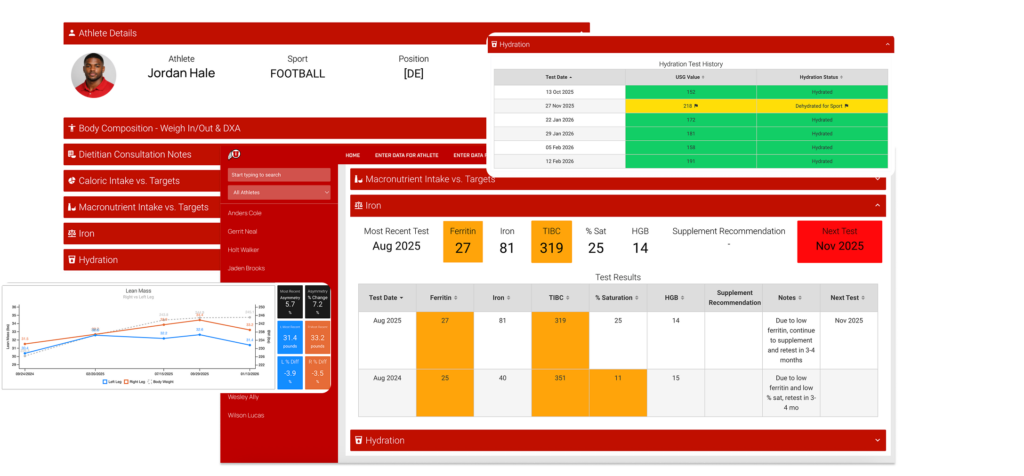
By bringing nutrition data into a single environment, dietitians can seamlessly move between clinical and performance responsibilities.
As Meredith shared:
“It’s improved our workflow, but more importantly, it’s improved how we care for our athletes. We can see the whole picture before we ever sit down with them.”
When nutrition insights are viewed alongside training and medical context, interventions become more precise and individualized.
The Foundation and the Future
Throughout the conversation, one theme surfaced repeatedly: consistent communication.
Leadership meets regularly and their Sport Performance Teams operate with defined checkpoints. Questions are encouraged and perspectives are shared openly across disciplines.
As Anna Cruse put it:
“The systems help, but the foundation is communication. That’s what allows us to actually function as one team.”
That foundation – communication, transparency, and trust – is what makes Utah’s integrated model sustainable.
And it’s also what makes it scalable.
For Utah, integration isn’t a finished initiative, it’s an evolving standard. The next phase isn’t about adding more tools. It’s about strengthening the relationships and systems they’ve built – across campus, across disciplines, and across performance environments.
As Patrick Jenkins shared:
“We want to keep removing barriers so our teams can focus on what matters, our student-athletes.”
Utah’s approach shows what’s possible when performance teams truly operate as one. They are a coordinated system – grounded in communication, transparency, trust, and collaboration.
Want to see how Teamworks Performance can support a more aligned performance team at your organization? Reach out to Luke Barthel at lbarthel@teamworks.com or reach out below to learn more.